Bonding Structure and Properties
1) What is Particle Theory ?
Also known as the Particle Model.
All matter is made up of particles.
Matter can exist in 4 states: solid, liquid, gas or aqueous
Matter can change state.
This explains how particles are arranged in solids, liquids and gases and what properties they have
At a certain temperature the particles have enough energy to break the strong forces holding them together (melting, solid to liquid)
At a certain temperature the particles have enough energy to break the weak forces holding them close together (boiling, liquid to gas)
2) Can you give some physical properties of a Solid ?
It is a solid when the temperature of the material is lower than the melting point.
hard/strong, fixed shape, fixed volume, high density, low energy
cannot be compressed easily
3) Can you give some physical properties of a Liquid ?
It is a liquid when the temperature of the material is between the melting point and boiling point.
can flow/be poured, fixed volume, medium density
cannot be compressed easily
shape changes to fill bottom of a container
4) Can you give some physical properties of a Gas ?
It is a gas when the temperature of the material is greater than the boiling point.
does not keep the same shape or volume
can diffuse, low density, high energy
can be compressed
gases have the same shape and volume as the container they are in
5) What are Nanoparticles ?
These are microscopic particles that measure between 1 and 100 nanometres in size.
They have a very low surface area to volume ratio.
6) What is Aqueous ?
This means dissolved in water, for example salt water or sugar water.
In equations this is represented with the symbol (aq)
7) What is a Dilute Aqueous solution ?
This is a mixture where a small amount of dissolved substance (the solute) is mixed into a large amount of water (the solvent).
8) What are the different ways that state can be changed ?
Melting - solid to liquid, increase in energy, particles break free from fixed position
Freezing - liquid to solid, decrease in energy
Boiling - liquid to gas, increase in energy, fill container (also includes Evaporation)
Condensation - gas to liquid, decrease in energy - happens at any temperature below the boiling point
Sublimation - solid to gas, particles break free from fixed position, increase in energy
Deposition - gas to solid, decrease in energy
9) Is Boiling and Evaporation the same thing and explain why ?
They are both processes that change a liquid to a gas but they are not the same thing.
Boiling is faster, only occurs are boiling temperature and occurs everywhere. The state slowly changes to gas creating bubbles that rise to the surface to escape.
Evaporation only occurs on the surface and can happen at any temperature.
10) Can you explain what causes pressure in a liquid ?
The liquid particles move and collide with each other and with the side of the container.
The average force of these particles (over the area of the sides of the container) is called the pressure.
11) What is an Ion ?
An ion is an atom (or group of atoms) that has a full outer shell after losing or gaining electrons
An ion also has an electric charge.
12) What does Ionised mean ?
This means that an atom (or group of atoms) has gained or lost electrons.
13) There are several ways that an atom can be ionised ?
When an atom loses or gains an electron, this is called Ionisation
Chemical Reaction = chemical ionisation
Radiation = physical ionisation
14) What happens when metals transfer/lose electrons ?
When metals lose electrons, there outer shell loses electrons.
They create positive ions (cations).
15) What happens when non-metals transfer/gain electrons ?
When non-metals gain electrons, there outer shell gains electrons.
They create negative ions (anions).
16) How much charge does an ion have ?
The size of the charge depends on the number of eletrons that are transferred.
17) Can you describe the different types of structures and bonding ?
structure describes how those bonded atoms are arranged in space
bonding describes how atoms join together
The three primary types of strong chemical bonds are ionic, covalent, and metallic,
18) How many different types of Bonding are there ?
There are three ways atoms can be chemically bonded.
Covalent - Most of these bonds occur between atoms of different non-metal elements when they share pairs of electrons. It results in simple molecular substances, polymers, or giant covalent structures.
Metallic - Occurs within metals due to the electrostatic attraction between fixed positive metal ions and a surrounding "sea" of delocalised electrons.
Ionic - Occurs between a metal and a non-metal when electrons transfer from the metal atom to the non-metal atom, creating oppositely charged ions.
19) How many different types of structures are there ?
Simple Molecular - Made of small molecules containing a few non-metal atoms held together by strong covalent bonds. The molecules themselves are bound by weak intermolecular forces, which require very little energy to break (giving them low melting/boiling points).
Polymers - Extremely long chains of non-metal atoms held together by strong covalent bonds. Intermolecular forces exist between the separate chains, making them solid at room temperature.
Giant Covalent Structures - Vast networks of non-metal atoms held together entirely by strong covalent bonds in a giant lattice, with no individual molecules and no intermolecular forces (e.g., diamond, graphite, silicon dioxide).
Giant Lattices - Giant, continuous three-dimensional structures. They are split into two categories: Giant Metallic Lattice: A regular arrangement of positive metal ions held together by a sea of delocalised electrons (e.g., copper). Giant Ionic Lattice: Oppositely charged ions held tightly in place by strong ionic bonds acting in all directions (e.g., sodium chloride).
20) What is Covalent Bonding ?
This happens when non-metal elements (and non-metal compounds) join together and share electrons in their outer shell.
This is when multiple atoms share electrons
21) What is a Covalent Compound ?
They consist of neutral molecules held together by strong internal bonds, but weak external forces.
The larger the molecule the stronger the internal forces.
22) What properties to Covalent Bonds have ?
Weak intermolecular forces
Low melting points
Low boiling points
Cannot conduct electricity
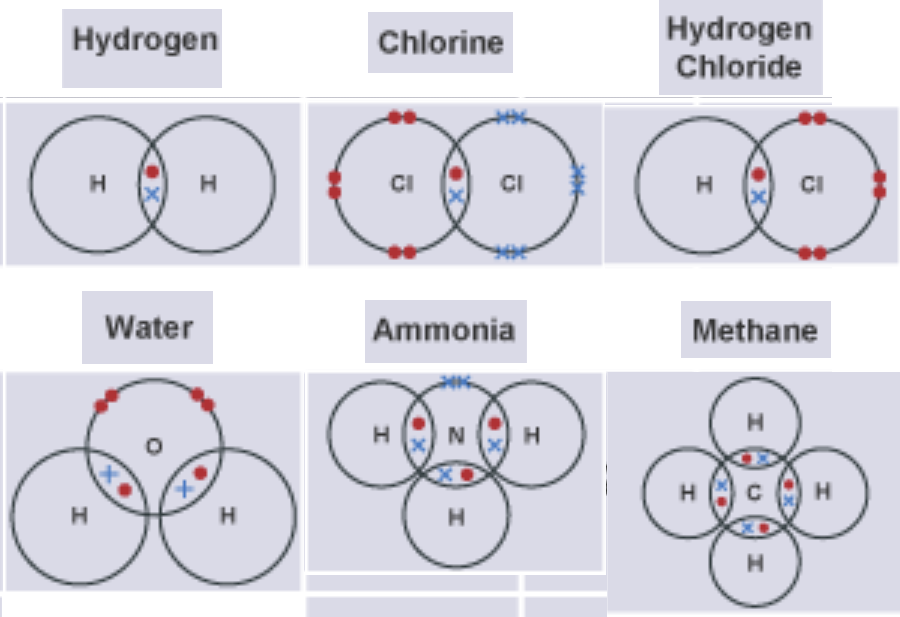
23) Can you give some examples of simple molecular structures ?
These are all multiple single covalent bonds.
A double covalent bond is formed when two atoms share two pairs of electrons.
 |
24) Can you give some examples of polymers ?
Small molecules (called monomers) can be joined together in long chains
Monomers are atoms or small molecules that bond together to form more complex structures such as polymers.
They can include metals and non metals.
There are four main types of monomer, including sugars, amino acids, fatty acids, and nucleotides.
These chained molecules that have a repeating monomer is called a polymer.
25) Can you give some examples of giant covalent structures ?
Diamond - Every carbon atom forms 4 strong covalent bonds in a rigid tetrahedral lattice, making it extremely hard
Graphite - Every carbon atom forms 3 bonds in flat layers. This leaves one free electron per atom to drift between layers, allowing it to conduct electricity.
Silicon Dioxide - The main component of sand, where silicon and oxygen atoms alternate in a massive 3D grid similar.
These all have high melting points and boiling points.
26) What is Graphene ?
Graphene is one layer of Graphite.
This is a single layer of carbon atoms joined together in hexagons.
27) What is Metallic Bonding ?
Strong electrostatic attraction between metal ions (positive) and a sea of delocalised electrons (negative)
The attraction force is an electrostatic attraction between positive metal ions and a sea of delocalized (free) electrons.
28) What is the definition of a delocalised electron ?
It is an electron that is not tied to any specific single atom.
All metals have a weak hold on the electrons in their outer shell which allows these electrons to move freely within the structure.
These moving electrons creates a sea of electrons surrounding the positively charged atoms.
The negatively charged electrons are strongly attracted to the positively charged atoms and this attraction is called metallic bonding.
29) What must happen before a metal can change from a solid into a liquid ?
These metallic bonds must be broken.
30) What is a Giant Metallic Lattice ?
All metals have giant metallic compounds.
31) What is an Alloy ?
A mixture of metal with other elements
32) Why are alloys harder than pure metals ?
Different sizes atoms disrupt layers, making sliding harder
33) What does Malleable mean ?
This means a material can be pressed or hammered into a new shape without breaking.
34) Why are metals malleable ?
Layers of positive ions can slide over each other without breaking bonds
35) What is Steel ?
Steel is an alloy of iron (Fe) and carbon containing less than 2% carbon (C) and 1% manganese (Mn) and small amounts of silicon, phosphorus, sulphur and oxygen.
Steel is the world's most important engineering and construction material.
36) Why is Steel harder than pure Iron ?
Steel contains atoms of other elements as well as iron.
These atoms have different sizes to iron atoms, so they distort the layers of atoms in the pure iron.
This means that a greater force is required for the layers to slide over each other in steel.
37) Why are pure metals soft ?
Layers can slide easily
38) Describe the structure of pure metals ?
Regular arrangement of identical atoms (shape + size) in layers
39) What is Ionic Bonding ?
This means that the atoms that make up the compound become ions.
The ionic bond is the force between the two oppositiely charged ioned.
The bond is the attraction between the positive ion and the negative ion.
This force is called an electrostatic force
All the atoms have a full outer shell of electrons
This type of bonding occurs when metals combine with non-metals
40) What properties do Ionic Bonds have ?
High melting points
High boiling points
Solid state cannot conduct electricity
Liquid state will conduct electricity
41) What is a Giant Ionic Lattice ?
All ionic substances form a giant ionic lattice when they are in the solid state.
42) What is an Ionic Compound ?
Ionic compounds are substances made from positive and negative ions that are held together by ionic bonding.
This happens when a metal and a non-metal chemically react.
Ionic compounds have high melting points.
43) What type of structure do Ionic Compounds have ?
They have a structure called a giant ionic lattice
The ions are closely packed in a regular arrangement and have very strong electrostatic forces.
44) What are Dot and Cross diagrams ?
These are diagrams that are useful for illustrating how ionic compounds are formed.
45) What is the difference between Chloride and Chlorine ?
Chlorine refers to the chemically unstable toxic gas before it reacts with anything.
Chloride refers specifically to the chlorine atom after it has gained an electron to become a negatively charged ion.
Chloride is therefore chemically stable and is formed from chlorine.
Chlorine is a diatomic molecule meaning that it always travels in pairs.
Chloride is what is created when Chlorine gains an electron and combines with other elements
46) Can you give some examples of ionic bonding ?
Sodium + Chlorine = Sodium Chloride
Na(2,8,1) + Cl(2,8,7) = Na(2,8) + Cl(2,8,8)
Magnesium + Oxygen = Magnesium Oxide
Mg(2,8,2) + O(2,6) = Mg(2,8) + O(2,8)
Magnesium + Chlorine + Chlorine = Magnesium Chloride
Mg(2,8,2) + Cl(2,8,7) + Cl(2,8,7) = Mg(2,8)Cl(2,8,8)Cl(2,8,8)
47) What happens when ionic compounds dissolve in water ?
They first dissolve and then they dissociate.
All substances that dissociate in a solvent, must dissolve first.
Not all substances that dissolve will dissociate.
48) What is an Ionic Equation ?
This is a chemical equation that shows the specific particles - such as dissolved ions or molecules - that actually take part in a reaction
Questions
49) In Ionic Bonding are the electrons always transferred from the metal to the non metal ?
Yes.
50) What is the difference beteen Iron, Iron(2) and Iron(3) ?
Iron refers to the neutral metal atom, while Iron(II) and Iron(III) are positively charged ions that have given away electrons to bond with other elements.
51) What is the difference between an Empirical formula and a Molecular formula
Empirical formula - shows the simplest, most reduced ratio of elements in a compound
Molecular formula - shows the actual, exact number of atoms of each element in a molecule
example Glucose has empirical formula CH2O (Ratio is 1:2:1), molecular formula C6H12O6
52) How does sodium conduct thermal energy ?
It is a metal with a giant matallic lattice.
Sodium contains delocalised electrons that move freely.
When at room temperature the thermal energy is converted into kinetic energy.
The thermal energy is conducted through the metal by delocalised electrons and the vibration of the positive ions.
53) Describe the chemical reaction of sodium + chlorine
Before - sodium is soft gray metal, chlorine is a pale green/yellow gas
During - the sodium metal burns and glows with an orange/yellow flame
After - get a while powder called sodium chloride
© 2026 Better Solutions Limited. All Rights Reserved. © 2026 Better Solutions Limited TopPrevNext