Polynomials
Second Order
Third Order
Straight Line
A first degree polynomial is always a straight line
y = mx + c
m is the gradient
c is the intercept
Simultaneous Equations
Methods you can use the solve simultaneous equations:
1) elimination
the coefficients of either x or y must be equal in both equations
often - multiply one of the equations and then subtract them
Common Factor
This is the process of finding the numbers (expressions) that multiple together to make a give number (or expression)
Greatest Common Factor
Removing Common Factor
Difference Of Square
Quadratic Equation
Also known as a quadratic polynomial or a second order polnomial or second degree polynomial.
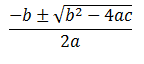 |
This is a second degree polynomial.
some quadratic equations can be factorised
Perfect Square
Grouping
Completing the Square
InEquation
An equation can be represented as a straight line
An inequation is represented by a region
y = 2x <= 9
2y + x >= 3
© 2026 Better Solutions Limited. All Rights Reserved. © 2026 Better Solutions Limited TopPrevNext